
Flashes and floaters can be alarming. Usually, however, an eye examination will confirm that they are harmless and do not require any treatment.
Symptoms Of Flashes & Vitreous Floaters:
- Seeing small, floating spots
- Seeing bright flashes of light
Causes Of Flashes And Floaters:
Aging of the eye: Most flashes and floaters are caused by age-related changes in the gel-like material, called vitreous, that fills the back of the eye.
When you are born, the vitreous is firmly attached to the retina. In the very young, the vitreous is rather thick, like firm gelatin. Within the vitreous, there may be clumps of gel or tiny strands of tissue debris left over from the eye’s early development. These clumps or strands are firmly embedded in the thick, young vitreous and cannot move around much.
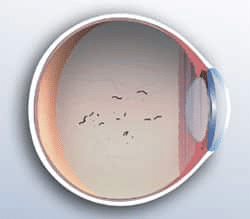
As you get older, the vitreous gradually becomes thinner or more watery. By the time you are in your twenties or thirties, the vitreous may be watery enough to allow some of the clumps and strands to move around inside the eye. This material floating inside the eye can cast shadows on the retina, which you see as small floating spots.
Sometime after about age 55, you may experience the onset of larger, more bothersome floaters or flashes of light. By this age, the vitreous gel has usually become much more watery. It jiggles around quite a bit when you move your eye, making flashes and floaters much more common.
Eventually, the aging vitreous can pull away from the retina and shrink into a dense mass of gel in the middle of the eyeball. Shadows cast onto the retina by the detached vitreous can cause you to see large floaters.

Who Is At Risk?
Flashes and floaters are very common. Almost everyone experiences them at one time or another. They become more frequent as we age. In rare cases, a doctor’s exam may reveal a more serious problem called a retinal tear or retinal hole, so it’s important to get regular eye exams and inform your doctor if you’re experiencing flashes or floaters.
Diagnosing Flashes And Floaters:
Using special instruments to look into your eyes, your doctor can distinguish between harmless floaters and flashes and more serious retinal problems such as holes, tears, or detachment. The usual symptoms of these more serious problems include seeing hundreds of small floating spots, persistent flashing lights, or a veil-like blockage of a portion of the vision. If you experience any of these, you should contact your doctor immediately.
Treatment For Flashes And Floaters:
There is no way to eliminate the floater through surgery, laser treatment or medication. With time, the floater will become less noticeable as the brain adjusts to its presence and can “tune out” the floater. The floater will always be somewhat observable and present, particularly if one eye is covered and the patient looks at a light-colored background.
Anyone with flashes or the sudden onset of a new floater should be examined promptly by an ophthalmologist. The ophthalmologist will perform a dilated exam and look at the vitreous and retina with specialized equipment. Sudden flashes or floaters could be symptoms of a vitreous detachment, which is a benign condition that carries the risk of developing into a retinal tear and/or retinal detachment.